

Cybersecurity Service Provider (CSSP) is an external organization or third-party vendor that protects an enterprise’s networks, endpoints, and data from digital attacks. Popular industry leaders inclu
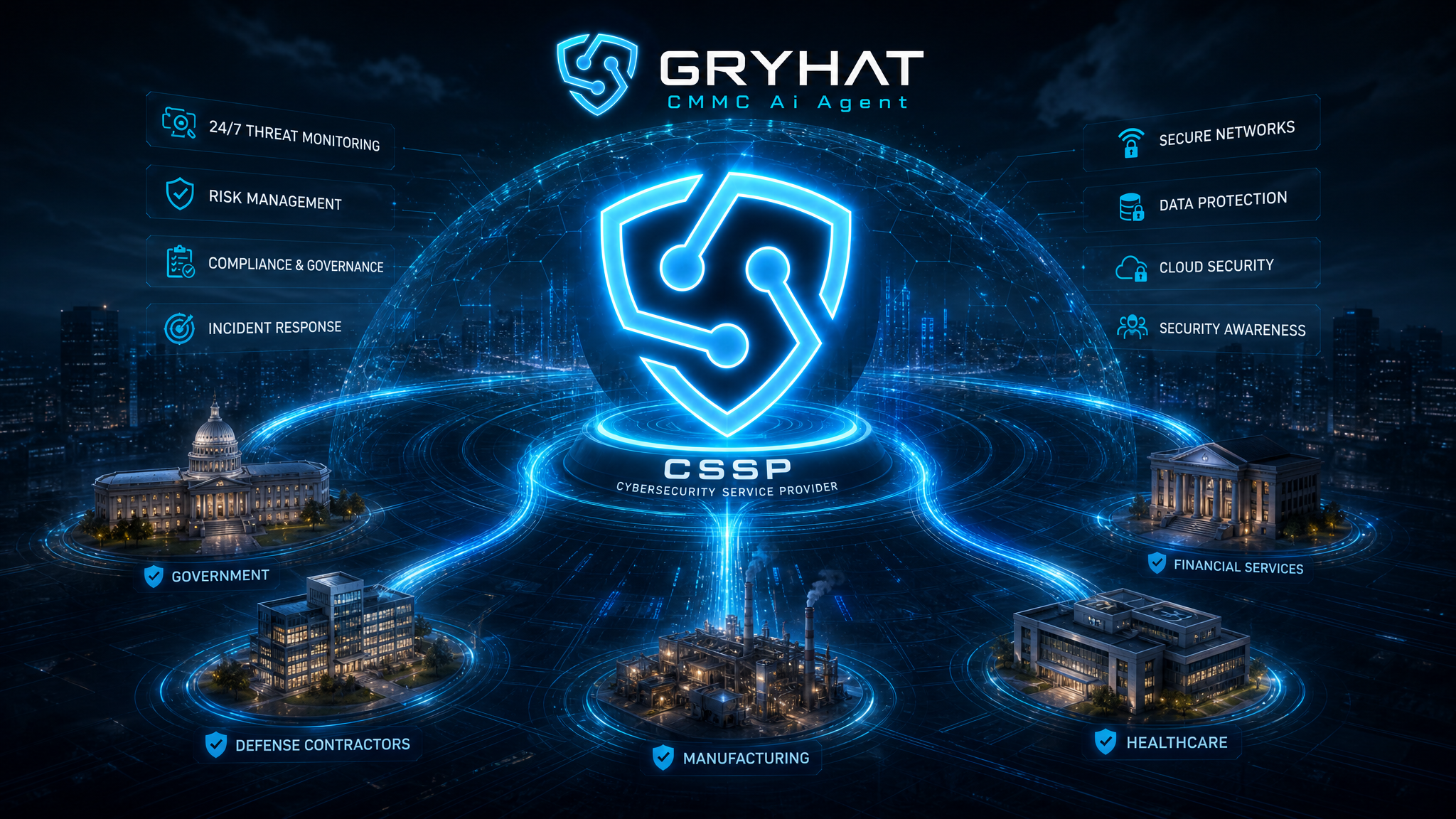
In 2026, breaches are not a hypothetical problem. For many teams, the most realistic defense question is whether they can prevent the first intrusion and still respond fast if it happens, and 47% of organizations now have an established policy to pay a ransom today.
Key Takeaways
What a CSSP does
|
How to choose one
|
- Compliance isn’t a checkbox. It’s an operational advantage you can prove, continuously.
- Threat response beats threat hope. 24/7 response and evidence-grade handling matter.
- Readiness mapping turns “we have security tools” into “we can stop and recover.”
- If you want a local team with California-First Architecture, start with local GRYHAT coverage and support.
- For audits and assurance work that plugs into day-to-day operations, see security audits and assessments.
- For the full services menu built on a cybersecurity foundation, browse GRYHAT cybersecurity services.
CSSP DEFINED: What a Cybersecurity Service Provider Actually Does
Cybersecurity Service Provider (CSSP) is an external organization or third-party vendor that protects an enterprise’s networks, endpoints, and data from digital attacks. Popular industry leaders include CrowdStrike, Palo Alto Networks, Fortinet, and Cisco, which offer threat monitoring, risk assessment, and incident response.
That definition sounds simple. In practice, the job is operational, continuous, and adversarial. A CSSP doesn’t just “monitor alerts.” We harden the environment, validate control effectiveness, and run incident response like it has a clock and consequences.
In 2026, the expectation is straightforward. Security services must cover the full path from prevention to detection to recovery, across:
- Networks (segmentation, ingress controls, identity-aware access)
- Endpoints (policy enforcement, detection quality, containment playbooks)
- Data (access control, logging, privacy-aware controls)
We also treat compliance as a living system. Not an annual scramble. Not a once-a-year spreadsheet.
WHY ENTERPRISES PAY FOR A CSSP IN 2026 (AND WHY IT SHOULDN’T BE OPTIONAL)
We see it every time, teams that bolt security on after the fact. The results look like outages, unclear evidence, and pressure decisions under stress. Approximately 18% of organizations only include security measures as an afterthought following a breach, exposing the vulnerability of the ‘security-as-a-bolt-on’ model.
Security-first work is different. It’s architecture first, then implementation, then continuous trust assurance. The CSSP model gives you specialized capacity, response readiness, and control validation without forcing your internal team to become a full-stack security lab overnight.
In the California market, we also have a practical reality. Data protection and regulatory expectations are not “later.” They are mission-critical now.
THE CSSP SERVICE STACK: Threat Monitoring, Risk Assessment, Incident Response
When we say Cybersecurity Service Provider (CSSP) is an external organization or third-party vendor that protects an enterprise’s networks, endpoints, and data from digital attacks, the next question is always the same. What exact services are you running, and how do they connect?
Here’s the CSSP service stack we build around, mapped to what enterprise teams need to operate:
- Threat monitoring for ongoing visibility, detection tuning, and signal quality
- Risk assessment that finds exploitable weaknesses, not just configuration gaps
- Incident response that contains impact fast and preserves forensic-grade evidence
- Security architecture with defense-in-depth and zero-trust design principles
GRYHAT’s operational ethos matches that stack. We run penetration testing as adversary simulation, we engineer compliance into living systems, and we provide 24/7 incident response with forensic-grade evidence handling.
CSSP SELECTION CHECKLIST: What to Ask Before You Sign
If you’re evaluating a Cybersecurity Service Provider (CSSP) is an external organization or third-party vendor that protects an enterprise’s networks, endpoints, and data from digital attacks, don’t ask generic questions. Ask operational questions that reveal readiness, speed, and proof.
Use this checklist in your evaluation calls. We’ve seen it separate tool vendors from true defense operators.
- How do you validate detection quality? Ask about control effectiveness and testing cadence.
- How do you run incident response? Ask about evidence handling, containment approach, and response SLAs.
- Do you run adversarial simulation? Scanning is not the same as testing real exploit paths.
- How do you translate compliance into operations? Look for CCPA/CPRA and CMMC “living system” language.
- What does “minimal overhead” look like? Mature CSSP teams can add security without slowing the business to a crawl.
We also recommend you confirm coverage depth across networks, endpoints, and data. That’s the core of Cybersecurity Service Provider (CSSP) responsibility.
GRYHAT’S CYBER SECURITY CONSULTING AS A CSSP-ALIGNED MODEL
We don’t just “provide security.” We engineer it, monitor it, and defend it like it’s part of your mission operations. That mindset is why our approach maps cleanly to what a Cybersecurity Service Provider (CSSP) is expected to deliver.
Here’s how our service portfolio supports the same CSSP outcomes of threat monitoring, risk assessment, and incident response:
- Penetration Testing as adversary simulation at the infrastructure and application layer, to find what automated scanners miss.
- Compliance Engineering for CCPA, SOC 2, and CMMC, translated into living systems, not binder-shelf documentation.
- Incident Response with 24/7 response and forensic-grade evidence handling when the perimeter fails.
- Security Architecture with zero-trust design from network to identity layer.
If you want to see how the services connect, start with our cybersecurity services, then run a free security assessment to map your readiness.

CALIFORNIA FIRST: CSSP SERVICES BUILT FOR ORANGE COUNTY AND BEYOND
We focus on California-First Architecture because your security posture has to match your compliance reality. That’s why we engineer security from the CCPA/CPRA gold standard and build forward with continuous trust assurance.
In 2026, businesses don’t just want “coverage.” They want operational clarity across the places they actually do business.
- cybersecurity companies Irvine need detection quality and response readiness, not vague dashboards.
- cyber security Newport Beach requires risk assessment that maps directly to real exploit paths.
- IT security Anaheim companies benefit from defense-in-depth architecture and control validation.
- cybersecurity Santa Ana businesses need a security foundation that reduces breach impact and evidence chaos.
- Huntington Beach cyber security teams should prioritize incident response speed and evidence handling.
- Costa Mesa cybersecurity services work best when compliance runs on autopilot.
If you want to explore local alignment, visit our Irvine cybersecurity support and choose the services that match your mission-critical risks.
HOW CSSP-STYLE WORK LOOKS FOR SMALL AND MID-SIZE TEAMS
People think CSSPs are only for large enterprises. In reality, the same problems hit smaller teams harder, because they have less internal security bandwidth.
For example, if you are a cybersecurity Santa Ana businesses looking to reduce risk quickly, a CSSP-aligned program usually starts with adversarial simulation, then moves into control hardening and continuous monitoring, then establishes incident response readiness.
We also see momentum around “automation-native” security. That means fewer manual choke points, clearer escalation paths, and security controls that don’t fall apart when key people are unavailable.
That’s the foundation we build with, and it’s why teams trust our operational ethos.
IMPLEMENTATION EXAMPLE: WHAT YOU GET WHEN THREAT MONITORING MEETS REAL TESTING
Threat monitoring without validation becomes noise. Risk assessment without remediation becomes paperwork. Incident response without evidence-grade handling turns into confusion in the middle of an emergency.
We combine the CSSP outcomes into a single operational loop. For teams in Fullerton cyber security companies and Mission Viejo cybersecurity, the goal is the same. Reduce exploitable exposure, improve detection confidence, and recover faster when something slips through.
Here’s what that operational loop typically includes:
- Adversarial simulation to identify vulnerabilities before attackers do.
- Remediation mapping so fixes are prioritized by real risk and business impact.
- Incident response readiness with forensic-grade evidence handling steps.
- Compliance translation into living system controls, not binder-shelf artifacts.
When teams do this consistently, they stop “reactive security theater” and start running a defense system.
FINDING THE RIGHT PARTNER NEAR YOU (Irvine, Newport Beach, AND MORE)
If you search for a CSSP-like partner locally, you’re really looking for one thing. A security foundation you can operationalize without the drama.
Here are local service angles that match how readers phrase their needs in 2026:
- cybersecurity companies Irvine often start with incident response readiness and security audits.
- cyber security Newport Beach teams usually want threat monitoring tied to validated risk.
- IT security Anaheim companies prioritize zero-trust security architecture and remediation mapping.
- cybersecurity Santa Ana businesses need practical compliance engineering that runs continuously.
- Huntington Beach cyber security requires fast containment and forensic-grade evidence handling.
- Costa Mesa cybersecurity services lean toward automation-native operations.
- Fullerton cyber security companies look for a security foundation that survives real-world change.
- Mission Viejo cybersecurity teams focus on CCPA/CPRA-aligned controls and continuous trust assurance.
- Laguna Beach cyber protection needs adversarial simulation to identify vulnerabilities before attackers do.
- Tustin cybersecurity consultants want security architecture and compliance engineering that connect to incident response.
If you want to understand our regional posture and how we connect services, start with GRYHAT Business Continuity and defense resources.
And if you want the fastest path to a security baseline, go through our local GRYHAT entry point, then run your first security assessment.
Conclusion
Cybersecurity Service Provider (CSSP) is an external organization or third-party vendor that protects an enterprise’s networks, endpoints, and data from digital attacks. Popular industry leaders include CrowdStrike, Palo Alto Networks, Fortinet, and Cisco, which offer threat monitoring, risk assessment, and incident response.
In 2026, the real difference is operational. We build security on a foundation that supports threat monitoring, risk assessment, and incident response, and we keep compliance running like an autopilot system. That is how we help teams move from “security tools” to continuous trust assurance, with a California-First Architecture built for the mission-critical risks that actually matter.
Frequently Asked Questions
Is a cybersecurity service provider (CSSP) worth it for a small business in 2026?
Yes, a Cybersecurity Service Provider (CSSP) is an external organization or third-party vendor that protects an enterprise’s networks, endpoints, and data from digital attacks. Smaller teams often lack the time and specialized skills to run threat monitoring, risk assessment, and incident response with consistency. A CSSP-style program gives you operational readiness without building a full in-house SOC from scratch.
What does a CSSP actually do during an incident?
A Cybersecurity Service Provider (CSSP) is an external organization or third-party vendor that protects an enterprise’s networks, endpoints, and data from digital attacks, with the primary goal of limiting impact and accelerating recovery. CSSP incident response typically focuses on containment, evidence handling, and forensic-grade documentation, then feeds findings back into hardening and monitoring improvements. Speed matters because damage scales with time.
How do CrowdStrike, Palo Alto Networks, Fortinet, and Cisco fit into the CSSP model?
Popular platforms like CrowdStrike, Palo Alto Networks, Fortinet, and Cisco align with the CSSP outcomes of threat monitoring, risk assessment support, and incident response workflows. A true CSSP approach goes beyond buying tools, it operationalizes those signals into tested controls and ready response playbooks. In practice, we validate that monitoring results translate into real defense.
How can I tell if a cybersecurity company Irvine partner is a true CSSP, not just a vendor?
Look for evidence of continuous threat monitoring plus real risk assessment, not just “alerting” and occasional reports. A CSSP-style partner should run adversarial simulation, map remediation to risk, and maintain incident response readiness with evidence handling. For teams searching cybersecurity companies Irvine, that operational loop is the difference.
What is the difference between a CSSP and a managed IT security provider?
Both can provide ongoing security support, but a Cybersecurity Service Provider (CSSP) is explicitly organized around protecting networks, endpoints, and data from digital attacks with threat monitoring, risk assessment, and incident response as core deliverables. Managed IT can include security basics, but CSSP-style work emphasizes adversarial readiness, validated controls, and incident recovery processes. The strongest programs connect all three.
Do I need a CSSP if I already have security software installed?
Security software is only one layer. A Cybersecurity Service Provider (CSSP) is an external organization or third-party vendor that protects an enterprise’s networks, endpoints, and data from digital attacks by validating controls, tuning detection quality, and running incident response when something breaks through. Without testing and response readiness, you risk turning alerts into noise and incidents into confusion.